
HMRC’s managed service company campaign
At last the politicians are showing some interest in how HMRC’s managed service company campaign is terrifying innocent taxpayers. Sir Geoffrey Clifton-Brown, Chairman of the Public Accounts Committee, wrote to the Chief Executive of HMRC in February 2026 asking some very pertinent questions. Here http://www.david-kirk.co.uk/ is my own contribution.

Sir Geoffrey Clifton-Brown, MP
Chair, Committee of Public Accounts
House of Commons
London
SW1A 0AA.
10th March 2026.
By e-mail
Dear Sir Geoffrey,
Managed service companies
1. On 12ᵗʰ February your committee wrote to the Chief Executive of H.M. Revenue & Customs, asking him some questions about their ongoing investigation of managed service companies. I write on behalf of 339 of the victims of this whom I represent professionally: as you mention, there are about 2,000 people affected in total. I have that interest to declare, and obviously certain matters are sub judice, so I shall not comment on things that only relate to those of my clients that have cases before the tax tribunal, nor on some of the intricate legal arguments that can be expected to be presented there. Please note that I do not represent the two accountancy firms, Boox and Churchill Knight, caught up in this mess.
Who I am
2. I am a Chartered Accountant and Chartered Tax Adviser specialising in employment status, and have
been advising on the managed service company legislation since its inception in 2007. My book
Employment Status: a Tax Guide (published by Claritax Publications) has a chapter on managed service
companies and is now in its fifth edition. I was the Institute of Chartered Accountants in England &
Wales’s representative on the IR35 Forum from 2012 to 2021 (this was an official meeting place for
HMRC, the tax profession, and trade representative of intermediaries on the subject of IR35; it now
has some other name).
Introduction and main points
3. This is an appalling story: it has so much that is wrong with it that it is hard to know where to begin. Many of my clients have compared it to the Post Office scandal, and whilst I have reassured them that they will not be going to prison, I have to say that there are otherwise many similarities. People faced with authority coming down on them like this assume that they are being accused of something criminal; HMRC need to make it clear that this is not so.
4. In summary, these people – mainly freelancers with particular expertise working on their own account; that is not say not big businesses – have been sent demands for tax in mind-bending amounts (the highest in my group is for £270,000); they will have to pay only a fraction of this even if HMRC turn Registered in England no. 7197969 at the address above out to be in the right; there is no suggestion that they have done anything wrong themselves; the proceedings are hugely labour-intensive, for HMRC, for the taxpayers and for their advisers, and they are going on for ever; and actions like this destroy confidence in the tax system.
5. Those affected include people who are terminally ill, people who have gone to live abroad, people who do not speak English as a first language, and people who have since retired and now just have their pensions to live on. It is as far away from the arena of aggressive tax avoidance that has so concerned the Revenue and the public as one can imagine.
6. The legislation is particularly problematic for taxpayers as there are transfer of debt provisions whereby the company directors can be made personally liable, and there are no provisions in the legislation or in Revenue practice for fault to be a criterion in making them so.
7. I do not expect appeals to be finished before 2029 at the earliest. This is far too long for innocent citizens to be kept in limbo (paragraph 18, first bullet-point).
8. HMRC’s demands take no account of tax already paid (see paragraphs 19 to 26). This is invariably substantial, and it was eighteen months into the campaign that they even acknowledged the fact.
9. These demands came out of the blue without any investigation of the taxpayers’ companies concerned, giving taxpayers no chance to provide information or answer questions beforehand. There have still been no investigations of the vast majority of these companies, to this day (paragraph 18, second, fourth and seventh bullet-points). Twenty-two victims formerly in my group have now had tax bills withdrawn by HMRC, after information has been provided that demonstrates they never should have been given them in the first place, demonstrating that HMRC did not do their job properly (paragraph 18, second bullet-point)
10. HMRC are charging an extortionate rate of interest on settlement of cases, in breach of their own policy that interest should only be for commercial restitution (paragraph 18, eighth bullet-point).
11. HMRC have not treated taxpayers equally or fairly in pursuing what they say they are owed. Those who have engaged with the system and appealed have years of anxiety, whereas those who ignored HMRC’s letters have got off scot free (paragraph 29a).
12. HMRC are in essence pursuing these accountants because they were technologically advanced in the way that they dealt with their clients, whilst at the same time mandating those technological advances for their clients’ filings (paragraph 29b).
13. Because of the way the legislation is framed, HMRC are having to pursue 2,000 freelancers instead of the two accountancy firms that they consider to be responsible for the putative underpayment of tax. This is very labour-intensive and expensive, both for HMRC and for the taxpayers (paragraphs 30 to 36).
14. These costs for HMRC are increased by court fees that they have to pay in National Insurance cases, which are substantial (appendix 3, paragraphs 6 and 7).
15. One of the firms of accountants (Boox) has been driven out of business by this campaign, depriving its clients – the affected taxpayers – of their natural defender (paragraph 38).
16. HMRC are in essence pursuing these freelancers because of the fact that they paid their accountants on a subscription model. Even if the law does technically allow HMRC to do this (a contentious sub judice point), it is not in the public interest that they should do so (paragraph 40).
17. There are a number of other points, mainly of tax policy, that are not strictly speaking in the remit of the Public Accounts Committee but provide important background information (see the appendices). Chief of these is that the law is no longer necessary as HMRC are achieving their objectives by other means (see appendix 4).
Your questions to the Chief Executive
18. Obviously I cannot speak for HMRC, but I can tell you of a number of matters that I think ought to be in Mr Marks’s reply, which at the time of writing has not been published as far as I can see. Taking your bullet-points in order:
• The test cases are being heard in June this year (for Boox – one of the two firms of accountants involved) and November (for Churchill Knight – the other). This is only the first round, however: appeals by the losing side to the Upper Tribunal and the Court of Appeal are a virtual certainty, which will probably take us into 2029. I should not be surprised if there is an appeal to the Supreme Court as well, taking us a year or two beyond that.
• What you say about HMRC issuing assessments before establishing a clear evidential basis is absolutely correct. In all but twelve of my clients’ cases, they had heard nothing at all about this until letters arrived in the post in March 2022 with tax determinations. They were never given an opportunity to answer questions that HMRC might have put to them: it was just straight in and pay up or appeal within 30 days. HMRC seem to think that they are entitled to investigate only the accountants. As their Employment Status Manual (page 3520) says: ‘Where it is clearly a standardised product constituting the MSC Provider being involved with client companies, it (HMRC) will take the starting view that all client companies are MSCs. The onus will then be on the individual companies to demonstrate no involvement.’
The way that HMRC went about this was not to investigate the companies but to investigate Boox and Churchill Knight – obviously, that was the whole idea behind the MSC legislation. I am not sure exactly when this started but I think that it was in about 2016 or 2017. Bearing in mind that they knew that they could not issue demands on Boox or Churchill Knight directly, they needed to know who their clients were in order to prepare to do this when the time came.
My understanding is that Boox and Churchill Knight very properly declined to provide them with this information, citing client confidentiality. However HMRC had a back door to it, in that all the companies operated a payroll, through which the director’s salary had to be put and which had to be reported to HRMC on-line and in real time. To that end Boox and Churchill Knight were appointed as the companies’ agents for PAYE purposes and recognised as such by HMRC, so HMRC knew anyway, and it must be presumed that they then used this information.
It must be questioned whether this was a proper use of that information, but even if it was it was in many cases all that they had. (They also appear to have done a trawl through Companies House records to identify companies that had Boox’s or Churchill Knight’s offices as their registered offices, but as a substantial number of these companies never did have that it cannot have been the basis for identifying these clients.) They did no work on most of the companies to establish whether they had been on the receiving end of the ‘involvement’ that was necessary to establish that they were MSCs, and nor on the other tests (not referred to in this letter so far) required to establish that in limbs (a), (b) and (c) of section 61B(1) of the Income Tax (Earnings and Pensions) Act 2003. (Without going into details, most of these companies would fulfil those conditions, but a significant number might not. I have not yet had time to investigate them fully, but out of my 339 clients I have logged 67 for further work to establish this.) HMRC have conceded that twenty-two companies (no longer in the 339) are excluded and as a result have withdrawn their tax determinations: eighteen as not paying half their turnover to their directors (s. 61B(1)(b)), three as being in the public sector IR35 system and so paying tax according to those rules (s. 61B(1)(c)), and one as being non-resident. They should never have been issued in the first place, and had HMRC done the necessary work on them in time they would not have been.
• Much of the language in HMRC’s communications is impenetrably legalistic. I do not see how anyone without a very knowledgeable and specialist adviser could be expected to understand a word of some of the letters that I have seen.
• As concerns the individual companies (as opposed to the accountants), there has even now been no investigation whatever in the vast majority of cases. There were, as I wrote above, twelve (out of 339) where they had done some work before issuing determinations, and they have done some additional work, mainly in establishing quantum, in some others where they have been specifically requested to by those others. That is as far as it goes. HMRC’s necessary fact-finding has been sorely lacking, and taxpayers have not been treated fairly.
• I am not in a position to answer whether the cases go beyond those reported in the Telegraph, although if any had spilled over into tax determinations being given to putative MSCs serviced by other accountants on any scale I would certainly know about it. If there are any such cases they are likely to be fermenting in secret, with only HMRC and the accountants concerned knowing about them; the unfortunate freelancers will only find out years later. In other areas, where HMRC suspect someone is involved in tax avoidance, they write to them – but for MSC cases, they were silent. This is inconsistent and unfair: HMRC have knowingly allowed tax debt to build up for taxpayers that could easily have been stopped. It is notable that clause 24 of the Finance Bill currently going through the House of Commons, introducing the new ‘purported umbrella’ rules, specifically includes a provision allowing HMRC inform those who may be on the hook, so they can make alternative arrangements.
• There was no plan to communicate with taxpayers before issuing tax bills to affected individuals (or, to be pedantic, their companies). As noted above, in the vast majority of cases there was no such communication, so there could not have been a plan.
• The investigations into individual companies have not been delayed – they have never gone on at all. Those into Boox and Churchill Knight were concluded in 2021 or 2022, and as far as the individual companies are concerned, apart from the small minority noted above there have been no investigations into any of the others. It has just been: ‘Here’s your tax bill and why we think you owe us the money – now pay up or you prove that you don’t.’
• Interest is dealt with by the Interest Review Unit, a completely different department in HMRC, and I know from experience that it takes a very long time to get a response out of them at all. They will not consider matters until all the principal is paid, so any result from that quarter is going to cause a further delay which, unless they are told from on high to accelerate matters and come up with a generic formula, will certainly be measured in years.
I should also like to draw the Committee’s attention to another matter concerning interest, which is that HMRC’s practice does not properly take into account interest calculations on tax already paid. If it ultimately turns out that these companies are all managed service companies, say when the Supreme Court gives a judgment in 2031, then HMRC will demand interest on the PAYE and National Insurance from the original due dates until then (2031) at the rate for late paid tax (currently 7¾%), for a period averaging 13 years. However as these companies will have got themselves into the wrong tax regime, they will be able to claim back Corporation Tax and their directors’ Income Tax paid in error, amounting to on average 70% of HMRC’s claim. HMRC will pay interest on this, but only at the rate for overpaid tax (currently 2¾%), for almost the same period. HMRC will thus be able to make a ‘turn’ of 5% (currently – it has been lower) on tax already paid for over a decade. As a result of this I would expect most of my clients to have an interest bill that is larger than the principal. Some already do. This strikes me as utterly scandalous.
• I hope that HMRC are able to present a realistic timetable for all this that includes an appeal to the Supreme Court, resolution of the exact amounts due, and a resolution of the interest issues that I have just described. When it comes to the exact amounts due, please note that the figures currently determined are only estimates and the exact amount will need calculating in every case. There will be an enormous amount of work involved in this, both for the Revenue and for the taxpayers, and it will be very easy to under-estimate the time that it will take. In the first case in my group where the client has asked me to effect a settlement I wrote to HMRC on 30th June 2025 to tell them this. The process has since required 29 e-mails and between HMRC and me, 2 hard copy letters from my client to HMRC, and 84 e-mails between my client and me, and the process is still not finished eight months later. If HMRC want to encourage people to settle their liabilities, this is a disastrous example. It is hard to see how they will be able to manage this with 2,000 cases without a very significant diversion of staff from other areas. I have started out on another two cases, but with some trepidation and a warning to my clients about just how exhausting this is likely to be.
HMRC’s failure to take account of tax already paid
19. Being a managed service company means that you make a ‘deemed employment payment’ every time you pay a dividend, which has four tax consequences, two beneficial and two adverse for taxpayers:
The company is obliged to deduct PAYE on the payment (adverse);
The company is obliged to deduct class 1 National Insurance, and to pay employer’s contributions on top (adverse);
The company gets a Corporation Tax deduction for the payment (which it would not normally do for a dividend – beneficial);
The company gets the dividend ignored for tax purposes, with a consequent reduction in the recipient’s Income Tax liability (beneficial).
One of the legal curiosities here is that these four consequences all have a common origin (payments from companies to their directors) but then operate independently of each other, so that because of other laws governing investigations and claims one party could be forced to pay the amounts that they owe but be unable to claim back the amounts that are owed to them. This could work to the detriment of either party – HMRC or the taxpayer.
20. HMRC may have been slow to issue demands for the first two of these, but they were slower still to draw anyone’s attention to the latter two. The original tax demands were issued in March 2022, but the first mention of the offsets came eighteen months later, and even that was after a certain amount of pressure from me. This ought to be automatic when one is dealing with people who are essentially private citizens operating one-person micro-businesses. Instead they were told that these offsets needed to be claimed.
21. Moreover, because of different time limits in operation it has been impossible to get claims in on time for the earliest putative overpayments of Corporation Tax. Although HMRC have said that they will consider late claims, they will not do so until the time comes to settle the amounts due, which will be years away. In my experience dealing with IR35 they probably will, but taxpayers need more assurance than this when they have had no opportunity to put claims in in time.
22. Also, the wording of a claim requires specialist advice. HMRC will not accept provisional claims but will accept provisional figures in claims, a rather arcane distinction if you are not a lawyer; also a claim has to have a figure in it, which is problematic when there is no final agreement on what the figure might be and even no agreement on the basis on which it is calculated. There needs to be a special regime for claims in this milieu (and also for the old IR35 rules where the same considerations apply).
23. The position for dividend claims is slightly easier as there are a special regime and a longer deadline this time. Nevertheless the deadlines have now passed, which causes similar issues for those who have not taken professional advice.
24. These claims give my Mr Average client a big reduction in his tax bill. It started at £65,841, was reduced to £30,945 because of HMRC’s faulty methodology in estimating it (a matter not dealt with in this letter), and now falls to £10,535 – a mere 16% of where it started out, and something which, whilst he would doubtless resent it, it would not be too painful to pay if he were to remortgage his house. It ought to be possible to get to something that can be readily determined without having to navigate this much bureaucracy.
25. HMRC ought to undertake to accept late claims up to the point at which settlement of the PAYE and NI issues are made. This would have the added advantage of making it unnecessary to make a claim at all in the event that the taxpayers win their case.
26. To write further about the law and its current application would risk venturing into sub judice territory, so I shall just make three further comments: firstly, that HMRC’s objections seem to be about the taxpayer companies operating a low salary/high dividend model to pay their directors, following advice that is absolutely standard from professional accountants; secondly, that people who are inside IR35 do not habitually use personal service companies – they will get the same take-home pay for far less work using umbrellas; thirdly, that many of these people were forced by industry practice to use companies – they were not given the opportunity of engaging directly with their clients or even with the agencies that found their work for them.
Covid
27. The period of HMRC’s investigation (April 2017 to April 2020) ended just as the first Covid lockdown
began, leaving many in the group out of work. Because they had been operating a low salary/high
dividend model of payments from their companies to themselves, they were only entitled to
Coronavirus Job Retention Scheme (‘CJRS’) payments based on those low salaries, typically about
£8,000 a year. One might say that that was fair enough – if people choose to pay themselves by way
of dividends they cannot expect the Government to take that into account when assessing how much
they have lost in the way of earnings. What is not fair however is to turn round two years after the
event, as HMRC have done, and say that those dividends should have been classified as earnings with
tax paid on them as such, but still not take that into account when assessing CJRS payments. Had
these people done as HMRC are now maintaining that they should have done, they would have been
entitled to vastly increased CJRS payments, frequently exceeding the net amounts of tax that HMRC
are seeking. HMRC’s essential message is: ‘You should have paid tax; if you had done at the time you
would have got Covid grants; we’re now coming for the tax but we’re not giving you the Covid grants.’
Heads you lose, tails you lose.
Is this a worth while use of HMRC’s time and money?
28. I have no idea how much the MSC campaign is costing HMRC, but I find it hard to believe that it is going to represent value for money. Because of the way that the law is framed, they have to deal with 2,000 taxpayers instead of just the two firms of accountants that they evidently have a problem with. Moreover, I should like to suggest that any figures that HMRC publish that do show tax collected, should show the amounts collected net of the Corporation Tax and Income Tax paid in error that I have referred to above. (All this assumes that they are going to collect anything at all, which they will not if they lose the test cases.)
29. Additionally, there are a couple of points that merit consideration from a value-for-money point of view:
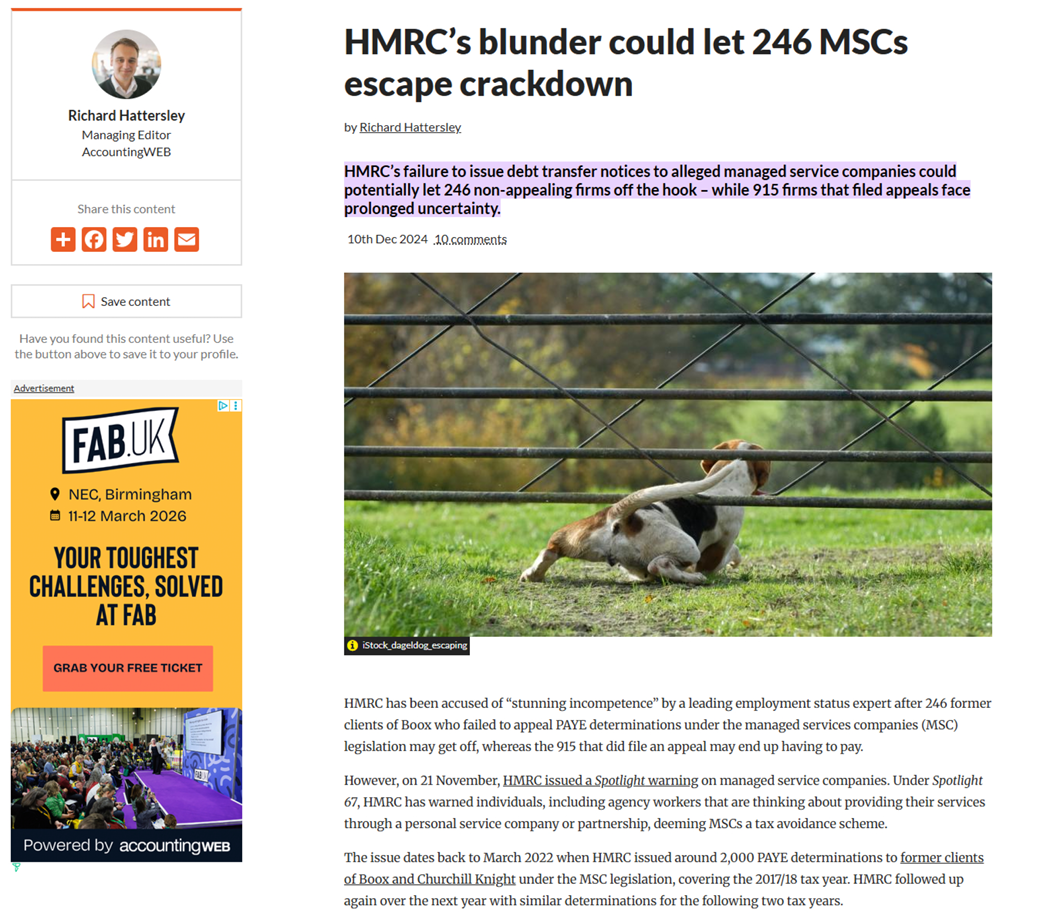
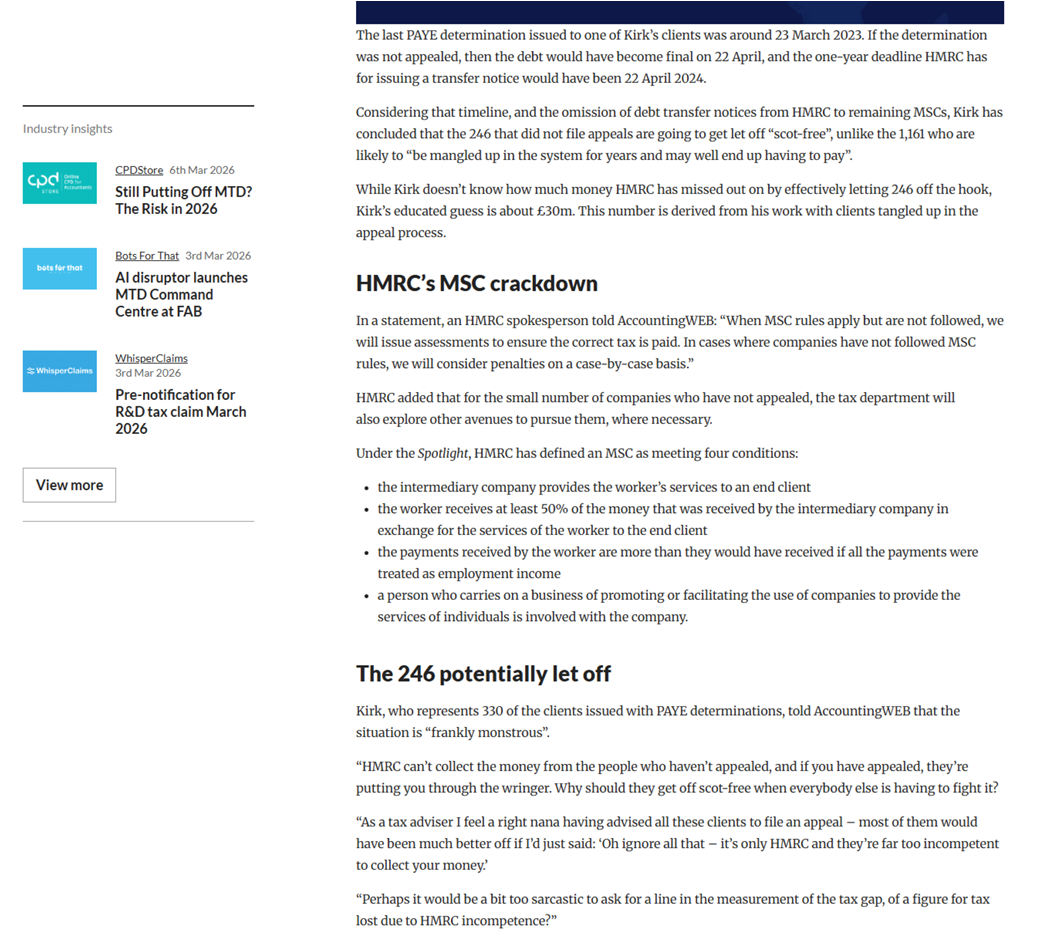
a. The system requires taxpayers to pay up or appeal once determinations are issued. Some 246 Boox taxpayers have probably neither paid up nor appealed (see the article in Accountingweb reproduced in appendix 2), and where the companies concerned have no funds HMRC will have lost their chance of recovering any debt. There are likely to be some Churchill Knight ones as well, although I have no figures. Whilst I have no specific information about these companies I would expect that the great majority of them will have ceased trading. From my group’s perspective this does not appear as the application of equal treatment under the law. The message given out by HMRC is: ‘Do the right thing and you’re in for years of stress and anxiety and a potentially large bill; ignore our demands and we’ll go away.’ That is not the way to maintain confidence in the tax system, and it has caused much bitterness amongst those who have played by the rules.
b. This item is sub judice although the matter has not been presented to the tribunal in these stark terms, so I shall confine myself to one simple observation: HMRC are gunning for the most technologically up-to-date accountants and so undermining what they are trying to get accountants to do. They are objecting to the issuance of essential tax advice and compliance services in bulk and on-line, yet they are encouraging and in many cases mandating taxpayers (including the affected taxpayers) to communicate with them on-line. On-line communication is surely a good thing as it means that the information coming to HMRC is more likely to be accurate and submitted on time, and at far lower cost for both parties. The information has to get into an IT environment at some stage – why not right at the beginning? HMRC are shooting themselves in the foot.
An enormous amount of work for HMRC in having to deal with 2,200 people instead of two.
30. Were HMRC able to treat this like a normal big business case, they would spend some time investigating Churchill Knight and Boox, discuss an amount for them to pay, issue an assessment and then take things with just these two parties through the next stages when they disagreed, and nobody else need be any the wiser. It is, after all, principally their behaviour that HMRC have been objecting to.
31. Because of the way that the law is framed, they have had to issue determinations not to two parties but to 2,200, and they appear to have a number of full-time employees on their team simply to deal with the paperwork. Moreover, on the other side the parties that they are having to deal with have become fragmented. HMRC were doubtless hoping that Boox and Churchill Knight would advise their clients on the paperwork and sit down with them (HMRC) in a series of convivial meetings to decide on five cases (each) to take as test cases in the Tax Tribunal.
32. This fails to take account of the fact that Boox and Churchill Knight had already disengaged from a large number of these PSCs who had ceased trading, and those remaining were left with an obvious motive for telling these accountants that their services were no longer required – if they had been MSCs, the safest way of making sure that they no longer were was to find a new accountant (added to which many of them, possibly unfairly, would quite naturally hold Boox and Churchill Knight responsible for getting them into this predicament and wish to change for that reason). The result is that HMRC are now having to talk to a ragtag army consisting of Boox, Churchill Knight, a number of new accountants, tax fee insurers, DIY enthusiasts, and me.
33. Twenty-six cases have (to my knowledge) surfaced in the Tax Tribunal, six of which were sent there neither by HMRC nor by Boox nor by Churchill Knight, but by a tax fee insurer who advised them when appealing to HMRC also to ask for a statutory review of their cases. Without going into what this entails, it locked them into a timetable whereby they had to appeal to the Tribunal long before anybody else did. Four more were foreign nationals who do not speak English as their first language, who were not professionally advised, and who asked for this review simply because they saw in one of HMRC’s letters that they could – they similarly got locked into a timetable and were given no warning that this was what they were letting themselves in for. Judgment has already been given against HMRC in another one on a procedural issue, so that they are barred from further participation in the proceedings: the judge’s oblique reference to ‘well intentioned incompetence’ in paragraph 86 suggests to me that she was just as exasperated by all these goings-on as everybody else.
34. All this has left both HMRC and the affected advisers scrambling to find a way to get the Tribunal to hear cases that it might benefit the whole 2,200 population to hear, in particular so that the Tribunal gets to hear the maximum number of issues with the minimum number of cases. This probably will now happen, but it has taken four years to get there and has not been an easy process.
35. If the lead tribunal cases are resolved in HMRC’s favour, most of the ones coming in behind will be likely to want to settle, although they will not be obliged to. They may well concede the principle that they were managed service companies and that a method of calculating the liability has now been established, but the actual calculations will still need doing in every case. The amount of work required for this will be astronomical – it will tie HMRC down for years.
36. Once that is done, we shall have the case that, in order to give effect to the Corporation Tax and dividend tax offsets, a completely different set of HMRC inspectors will have to be drawn in to complete the paperwork, as the inspectors conducting the inquiry are PAYE specialists and do not have the authority to do this. I find it very hard to believe that the Corporation Tax inspectorate is going to consider it a good use of its time to be dragged away from its normal work of taking tax from companies, in order to process the paperwork required to give it away to 2,200 other companies in an exercise dreamed up by PAYE inspectors. The same goes for the self-assessment inspectors who will have to deal with the dividend tax offsets. If this is to go smoothly and not frustrate the taxpayers, it will require very good communications between three HMRC departments that do not often have to work with each other. This is not a certainty.
37. As noted above, I do not think that this law is any longer needed anyway. If it is retained, it should be amended so that it is the MSC provider that HMRC can claim against, not the MSC. If that is not possible, there should be a unified regime so that the same people in HMRC assess the PAYE, NI, Corporation Tax and self-assessment issues.
One of the accountants – Boox – went out of business as a direct result of HMRC’s attack on its clients
38. Boox went out of business in November 2022, saying (credibly in my view) that the issuance of these tax determinations had led to such a haemorrhaging of business as well as costs of dealing with HMRC’s claims that it was no longer viable. Basically, simply by asserting that a company is an MSC provider HMRC are placing the Mark of Cain on it, and leaving its clients without their natural defender, or indeed any defender unless they can find one for themselves. The system needs to change so that HMRC’s dispute, formally as well as informally, is with the putative MSC provider not the putative MSC.
The expense to the taxpayer of dealing with this
39. Mr Average has been presented with a bill for £65,000 of extra tax to pay, essentially for choosing the
wrong accountant. He believes that HMRC are mistaken but the burden of proof is on him, including
on the crucial issue of whether the accountant’s business makes it an MSC provider, a matter which
is not within his knowledge. Even a simple case will cost about £25,000 to take to the tax tribunal –
this one is not simple and looks as though it needs a barrister. Bearing in mind the chance of losing
and the probable cost of further appeals it is never going to make economic sense for him to spend
that sort of money on an appeal. Unless he can pool resources with others he would be much better
off giving in and putting this whole episode behind him, but he does not know anyone else affected
to join forces with. (He does now, in this case, but that is because Dave Chaplin from Contractor
Calculator and I have set up a group to deal with it, which would not be normal.) Why should he have
to?
Revenue overreach in deciding what constitutes that bad behaviour
40. One of the issues to be tried in the test cases concerns the method by which the accountants are paid.
The only legal precedent for most managed service company issues is to be found in Christianuyi Ltd
and others v. HMRC, where the Upper Tribunal judges seem to have decided that a subscription model
of monthly payments brings the taxpaying companies into the frame as MSCs. (The reference for
this judgment is [2018] UKUT 10 (TCC) – the subject was further considered by the Court of Appeal,
but they did not revisit this particular issue.) Hardly any accountants operated a subscription model
with small company clients when the legislation came in in 2007; now virtually all do. It must be
asked whether it is in the public interest for HMRC to be taking this line even if it is technically
permitted by Christianuyi – it certainly seems ridiculous on the face of it and I would suggest is in
danger of bringing them into disrepute.
Tax policy issues
41. I understand that issues of tax policy are not the remit of the Public Accounts Committee, but they make important background information. They show a system that has grown rather like a medieval house: when a new piece is required, it is just added on without much regard for the effect on the rest of the artifice. The result is the state abusing its powers against its citizens.
42. These policy considerations are dealt with in appendices 3, 4, 6 and 7.
Conclusion
43. This is no way to treat upstanding hard-working citizens – British or foreign (and many of them are
foreign) – who have made every effort to be compliant with their tax obligations, and thought that
they were engaging a firm of accountants to do exactly that. At a time when we are struggling to get
people in the pre-retirement cohort back to work, HMRC have metaphorically put up a large sign
saying CLOSED FOR BUSINESS on the White Cliffs of Dover. People will not go into contracting
in Britain if they think that this is going to happen to them.
44. This is a cat’s cradle of bad law, being administered by an organisation with no common sense. Someone needs to untangle it, or if that is not possible cut through it altogether.
Appendix 1: The history and application of the MSC legislation
The managed service company legislation was introduced in 2007 as anti-avoidance legislation for IR35.
HMRC were having great difficulty policing IR35, because inquiries were very time-consuming, they did
not always have much idea who to investigate, and when they did there was frequently no money in the
companies anyway.
They noticed that specialist accountants had set up in the freelance contractor business who had geared
themselves to do things at scale to deliver the low-salary/high dividend model that in those days had some big tax advantages – big enough to be worth while even with additional accountancy costs to pay. Instead of the company owner, who received these dividends, also being its director, it was an attractive
proposition to many to let the accountant be the director as he could then make the necessary decisions
about dividends and salaries without having to bother the owner with them. It was not long before these
‘operators’, as one might call them, started getting further economies of scale by lumping about a dozen
people who had never met each other into a single company, known as a ‘composite’, and giving these
people what lawyers know as ‘alphabet shares’ (i.e. person A got ‘A’ shares, person B got ‘B’ shares and
so on, and under the articles of association the director could declare whatever dividends he liked, so that
person A did not have to be paid pari passu with person B). In practice the dividends declared bore a
strangely close relationship to the amount of money that these persons were bringing into the company.
Obviously in this set-up none of these individuals had any contractual right to the dividends that they were getting, but they were happy as long as they were getting more – and without the hassle – than they would have been as PAYE employees, and if the expected money did not materialise for any reason it was a relatively simple matter to find another ‘operator’ and switch accountants.
HMRC suspected that many of these ways of working were actually inside IR35, and in order to counter
this issued a consultation document at the end of 2006 proposing a change to the law, so that companies
that were controlled by parties outside the ownership of the company would have to pay all their owners
under PAYE. The virtually unanimous response to this was that the definitions of control were
unworkable, and so only a few days before the 2007 budget the Revenue’s response came that they were
going to operate a different test, focussing on the behaviour of the operators. This relied on a two-stage
test of there being an MSC provider, defined as being a ‘person who carries on a business of promoting
or facilitating the use of companies to provide the services of individuals’, and that MSC provider being
‘involved with’ these companies. This is in the Income Tax (Earnings and Pensions) Act 2003 (‘ITEPA’),
s. 61A, and there is an exemption saying that ‘a person does not fall within [the definition of an MSC
provider] merely by virtue of providing legal or accounting services in a professional capacity’. Being
‘involved’ is defined in five different ways, of which any one will make a company an MSC. HMRC are
in this instance alleging three, viz. the MSC provider:
‘benefits financially on an ongoing basis from the provision of the services of the individual;’ …
‘influences or controls the way in which payments to the individual … are made;’
‘influences or controls the company’s finances …;’
This was immediately effective in closing down the composites. Its rather loose definitions, however, were drawn wider than was needed to do that, and have encouraged HMRC to look further afield. They were even more encouraged by the decisions of the courts in the case of Christianuyi Limited and others v H.M. Revenue & Customs, finally decided in the Court of Appeal in 2019 (ref. [2019] EWCA Civ. 474). This concerned an ‘operator’ called Costelloe and what it had been doing in the immediate aftermath of the new rules coming in a decade earlier. It is the virtually unanimous consensus of legal tax-watchers that the courts were right in finding that Costelloe was an MSC provider and so its clients were operating on the wrong side of the law. However HMRC’s victory was given to them by the courts on terms they had not even asked for; these terms put all accountants at risk of being MSC providers.
Appendix 2: HMRC’s failure to pursue some cases as described by Accountingweb



Appendix 3: Differences in the rules for enforcing the collection of National Insurance (‘NI’) and PAYE
1. We are now in an environment that only specialist tax consultants experienced in dealing with contentious long-running National Insurance cases know about. I have heard on the grapevine that some professional advisers are refusing to advise on this issue. It concerns time limitations.
2. For PAYE and most other taxes HMRC are under a time limitation to issue demands or forfeit their rights; for PAYE this limit is four years from the end of the tax year in which the debt arose, unless carelessness can be established. (Note already that this is a lot longer than the PSC directors will be used to when dealing with their self-assessment tax returns, where the limit is one year from the filing of the return – in other words under two years from the end of the tax year.)
3. For NI there is no time limit for issuing a demand, but as it is not considered to be a tax (seriously) the Limitation Act applies, which for taxes it does not. This means that HMRC cannot enforce any claims that are over six years old at the time that the debt was incurred. That in turn means that where NI cases are contested, the matter has to be fought in two courts – the Tax Tribunal to establish whether or not there is a debt, and the County Court to enforce any debt that there is.
4. It would obviously be sensible, and less costly, to have a system whereby one can establish whether there is a debt before any attempt is made to enforce it. The Limitation Act prevents this: for NI HMRC must initiate an action in the County Court within six years of the debt becoming due or forfeit their claim. This just means another round of bureaucracy for everyone: if they do that, the putative MSC then has to file a defence saying that no tax is due, and HMRC write to the County Court asking for an adjournment whilst the Tax Tribunal determines whether or not there is debt. In my experience HMRC’s solicitor’s office have not always written to the court asking for this adjournment in time, leading the court to do things of its own motion without having first been reminded of the special rules affecting this kind of case. This leads to a further bureaucratic tangle which it takes time and effort to undo.
5. In order to avoid all this, HMRC have suggested that all the putative MSCs should enter into ‘standstill agreements’ whereby time ‘stands still’ so that the clock stops ticking on the six years and HMRC can issue proceedings, should the need arise, at a later date. The benefits to the PSCs are that they do not have to deal with another layer of bureaucracy, and they are not at risk of paying an extra 5% in court fees where the County Court is involved.
6. A rather greater benefit accrues to HMRC who would actually have to pay these court fees if they went to court. The standard fee for issuing a court claim varies but is in the region of 5% of the value of the claim, which on the basis that they think that there is about £40,000,000 in National Insurance to claim (my estimate), would cost them £2,000,000. If one then assumes that a quarter of the PSCs do not reply to their request for standstill agreements (my supposition), this means an outlay of £500,000.
7.They would be unlikely to get much of this back. Even if they win their cases in the Tax Tribunal, many of these companies have ceased trading and have closed their bank accounts; by the time all this is finished even more will have done. HMRC will be expecting to collect the NI not from the PSCs but from their directors, Churchill Knight and Boox under the debt transfer provisions. This 5% will not be transferable in the same way. It might be worth while asking HMRC how much they have spent on County Court fees.
8. Rules for collecting NI contributions need to be aligned with those for PAYE.
Appendix 4: Is the law still needed?
IR35 inquiries are lengthy, microscopically detailed, and absolutely miserable for the taxpayer (I know
from having handled a number myself). Because they – almost by definition – are targeted in a grey area
(see appendix 5), they are of very uncertain outcome and HMRC tend to take rather pernickety points that
do not reflect the general picture. In my experience HMRC officers frequently have difficulty
understanding work cultures very different from their own. Judges faced with employment status
decisions have said that the issue is difficult, and are forced to make value judgments that it is not really
fair to impose on them. In one case that I shepherded through the tax tribunal, involving three BBC
presenters, we had to get the legal team to work pro bono because there was simply no way that the case
could be presented for less than the tax at stake.
It did not prove cost-effective for HMRC to investigate thousands of tiny PSCs and so they looked for
ways of doing things in bulk. The first attempt was the managed service company legislation, which as I
noted above was effective in stamping out practices that people thought that it was aimed at, but not at
practices that look both to accountants and to their clients to be perfectly legitimate. The second was the
public sector off-payroll rules, introduced in 2017 and extended to the private sector in 2021. This has
transferred the tax liability to end-clients and agencies and so is no longer the PSC’s or its director’s
problem. It has in my view been effective, to the point where HMRC no longer need the MSC legislation
anyway.
This suggests that the MSC legislation is no longer needed. If it is retained, it should be amended so that
it is the MSC provider that HMRC can claim against, not the MSC. If that is not possible, there should
be a unified regime so that the same people in HMRC assess the PAYE, NI, Corporation Tax and self
assessment issues.
Appendix 5: The grey area between employment and self-employment
For most people their status as employed or self-employed is pretty clear, but I recall from an academic
paper that about 3% of the working population is difficult to categorise. (Regrettably I cannot find this
paper but the figure makes sense.) It tends to be these cases that hit the headlines, particularly when they
concern media stars who are frequently in the headlines anyway, as many recent IR35 cases have done.
All countries have this problem, but it is a particularly acute one in Britain because of our tax regime. I
do not know of any other countries where you can lower your tax bill by trading through a company.
Appendix 6: A law which passes the tax bills for accountants’ bad behaviour on to their clients rather than themselves
HMRC’s real argument is not with any of the victim companies but with Boox and Churchill Knight – it
is they who either fulfil or do not fulfil the all-important definition of being an MSC provider and it is they
who may or may not be ‘involved’ with these companies. ‘Involvement’ is also something that the
companies participate in too, albeit in a passive way, but HMRC can look – and have looked – at the
accountants’ side of this in bulk whereas the company side will require a separate look at each company.
This being so, a sensible tax regime would penalise the accountants for getting things wrong, rather than
penalising the companies for having the wrong accountants. However the MSC legislation does not permit this – it is the MSCs that are liable for the extra tax, and so HMRC have had to hand out 2,000 demands instead of two, and what is more on people who could not reasonably be expected to see this coming. This is causing a simply fantastic amount of extra work, both for taxpayers and for HMRC, as well as roping in entirely innocent people.
HMRC do of course have the right to issue transfer notices to Boox and Churchill Knight, making them
responsible for the debt (this is a special feature of the MSC legislation). However this can only be done
once all appeals are exhausted and when and to the extent that the companies cannot pay. It is of no
consolation to the PSC owners who can also be expect to be on the receiving end of these notices.
Appendix 7: The artificial creation of an employer enabling HMRC to collect an extra 15% in employer’s National Insurance contributions
This needs to be considered in conjunction with the old IR35 rules, which still apply where the end-clients
are small or foreign companies. HMRC take the view that, where there is deemed employment,
employment taxes should be paid, which includes employer’s National Insurance contributions. However
in the old IR35 rules the deemed employer is the contractor’s PSC whereas the economic employer is the
end-client. This means that it is the contractor who bears this tax, not the client who would do if the PSC
did not exist. This causes a great deal of consternation when victims of IR35 inquiries are told that not
only do they have an employer, but they are going to have to pay that employer’s tax.
This principle has been extended to the MSC rules, except that in this instance no attempt is made to
identify the employer – it is just assumed that there must be one because it is IR35 anti-avoidance
legislation. In Mr Average’s case the employer’s NI part of the bill is £9,218, leaving a mere £658, or 1%
of the original bill, as arising from his side of the reclassification as a deemed employee. Almost anyone
can afford that and very few people would go through all the expense and emotional anxiety of contesting it.
What this in effect means is that classifying a company as a managed service company entitles HMRC to
make a large charge of employer’s National Insurance and levy it on the employee. It is both oppressive
and bonkers at the same time.
Appendix 8: Self-employed people being forced to engage through companies
Personal service companies started out in the IT sector in the 1960s, when consultants wanted limited
liability. (If you are a 30-year-old doing the IT for a large city bank, who has just taken on a mortgage and
started a family, even a small error could cost your client millions, and limited liability would be a sensible
precaution to take.) There were no real tax advantages then, and in the 1970s even tax disadvantages – it
was only in the 1980s that this changed. In the ensuing years changes in company law (in particular the
abolition of the audit requirement and of the requirements to have two directors and two shareholders)
made this more attractive still, as did tumbling accounting costs brought on by better IT.
Once it had become a realistic possibility for large numbers of people to have their own PSCs, big business and the public sector began to like this too, as it meant that they could take on labour without having to give away employment rights that were in turn becoming more and more onerous for them and difficult to navigate. It therefore began to become a requirement, most notably in IT and in the financial services sector. It is now a fairly general requirement in many (but not all) sectors of the contractor market. It must be asked whether it is ever right to refuse to contract with someone other than through a company, and I would suggest that the public sector could make a start by not insisting on this.
Appendix 9: Public hostility to those who do engage through companies as being perceived as tax avoiders.
As members of the Committee will very well know, there has been much hostility in the public eye to
those who engage in ‘tax avoidance’, but the public’s view of what constitutes this is rather inchoate.
Whilst an old-fashioned accountant or lawyer might well regard avoidance (i.e. within the law) as
acceptable and evasion as not acceptable, the public generally tend to judge both avoidance and evasion
by who is doing it, regarding both as legitimate when done by local people who are not too well off and
both as illegitimate when done by the rich or big companies.
There is a sector of the public that has got the message that setting up a company allows you to lower your tax bill and so considers this to be automatically a form of avoidance. Media stars have got into particular trouble because of this. The message needs to get through that many people have no choice.
Moreover I should suggest that for many right-thinking people there are two sides to this consideration:
people should pay their taxes to the Government as long as the Government does not make oppressive
demands on them. What is an oppressive demand is obviously a matter of opinion, but in this instance I
do think that HMRC’s demands are oppressive, both in the manner of their execution and in their trying
to claim an extra tax that self-employed people do not normally pay (i.e. employer’s National Insurance
contributions – see appendix 7).
It is also worth mentioning that the tax advantages of setting up a company are now largely illusory – when one takes the extra accountancy costs into consideration it is only really worth while for those earning between £50,000 and £70,000 a year or living in Scotland. This is however a very recent development.
Appendix 10: Companies House failing to tell company directors when HMRC have objected to their companies being struck off the register
HMRC have gone back to April 2017 in their pursuit of tax, yet their first determinations, and the first
that most of the affected people heard about this, were not issued until March 2022. In that time many
of these companies ceased trading – probably a majority, on account of Covid and the introduction of the
off-payroll rules – and Churchill Knight and Boox took the necessary steps as instructed to wind up their
affairs and get them struck off the register of companies. On receiving this application Companies House
would have written to all the company directors saying that the application had been received and the
company would be struck off unless cause was shown to the contrary within two months.
What Companies House did not then do was to inform the directors, or anyone else, that their companies
would not be struck off because HMRC had objected to this – to find this out the directors would have
had to have looked up their companies’ records on the Companies House website, and then rung up
Companies House to find out who the objecting party was. Most of them never gave this a thought –
they had never had any contact with Companies House and would not have known where to look if they
had done.
Even if they did, it would not have enlightened them much because Companies House would not have
known which department of HMRC had objected and they would have had no effective way of finding
out from HMRC themselves. Had they been able to, they would have been able to take action to deal
with this very much faster – anything up to nearly five years earlier – and not received a nasty surprise out
of the blue in March 2022. Amongst other things, they will, if HMRC are right, have been running up
interest bills for five years without any means of knowing this, and so unable to take any preventive action
on that by making payments on account, which some of them have been in a position to do.
Moreover, it is a criminal offence to fail to file accounts or confirmation statements on time for a company of which one is a director. I had not previously known Companies House take any action against directors for this where strike-out has been applied for, but one client (an EU citizen now resident in the Gulf) has reported to me having received an e-mail from Companies House threatening referral for prosecution for exactly that if she did not rectify her position within 28 days. She was thus in the unenviable position of risking a criminal record if she did nothing, or paying late filing penalties of £8,250 if she filed the late accounts.
Companies House should inform company directors if they are suspending strike-out of companies
because of objections, and tell the directors who has objected. HMRC should also inform company
directors where they are objecting, and give the name, contact details and a reference to those directors to enable them to make further enquiries.